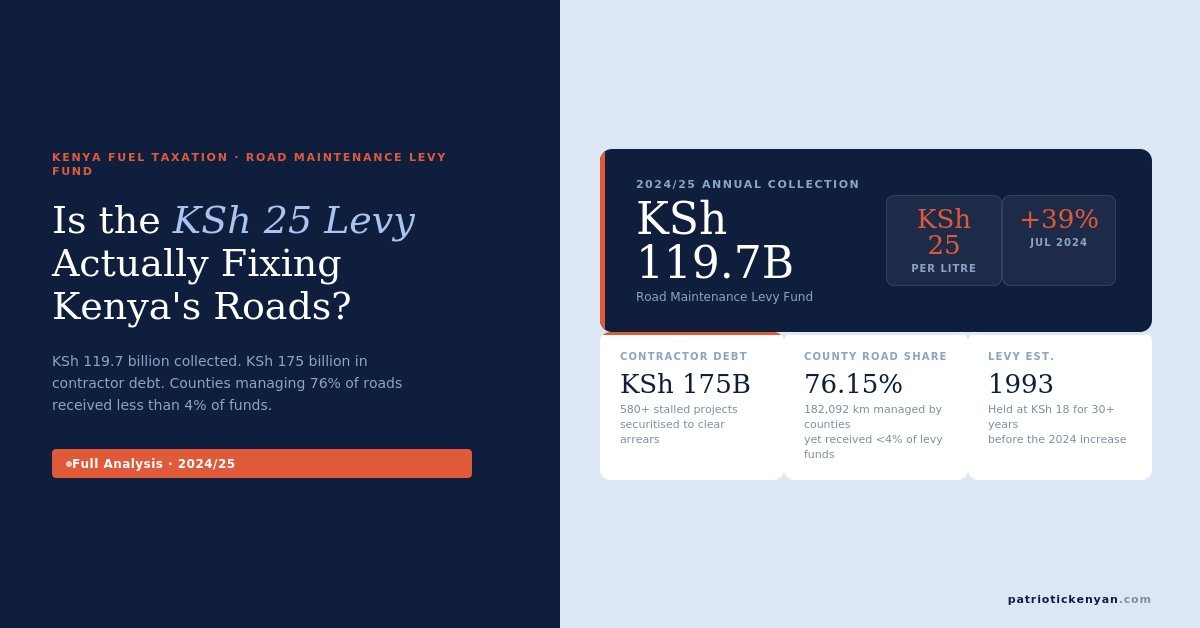
Every time you fill up at a petrol station in Kenya, a portion of what you pay is a direct contribution to road infrastructure. That contribution, known as the Kenya Road Maintenance Levy, currently sits at Ksh 25 per litre, up from Ksh 18 before July 2024. Collectively, Kenyan motorists put over Ksh 119 billion into this fund in the financial year ending June 2025. Yet roads remain a persistent frustration for most people. Below, we break down how the levy works, where the Kenya roads budget goes, and why the numbers do not always translate into better tarmac.
Table of Contents
What Is the Kenya Road Maintenance Levy?
The Road Maintenance Levy Fund was established through an Act of Parliament in 1993 with a clear mandate: collect a portion of fuel sales and channel it toward maintaining public roads. The Kenya Roads Board is responsible for collecting and distributing the funds to three national road agencies, the Kenya National Highways Authority, the Kenya Rural Roads Authority, and the Kenya Urban Roads Authority. Each agency is tasked with a specific segment of the road network, from major national highways to rural access roads and urban streets.
The levy applies to every litre of petrol and diesel sold in the country. When the government increased it from Ksh 18 to Ksh 25 per litre in July 2024, it was the first revision since 2016. The hike came amid a documented maintenance deficit of Ksh 78 billion for FY 2024/25, a figure projected to grow to Ksh 315 billion by FY 2028/29 without intervention.
Kenya’s National Roads Budget for FY 2025/26
The fuel levy is not the only funding source for roads. The national budget provides a direct annual allocation for road development, separate from RMLF collections. For the financial year 2025/26, Treasury CS John Mbadi proposed Ksh 217.3 billion for road development, an increase from the previous year’s Ksh 193.4 billion.
The table below shows how the FY 2024/25 roads allocation was structured:
Looking ahead to FY 2026/27, the government plans to construct 1,891 km of new roads, rehabilitate 515 km, and maintain over 89,000 km of road network, backed by a development budget of Ksh 158.3 billion and a recurrent allocation alongside it.
How the Ksh 25 Per Litre Is Distributed
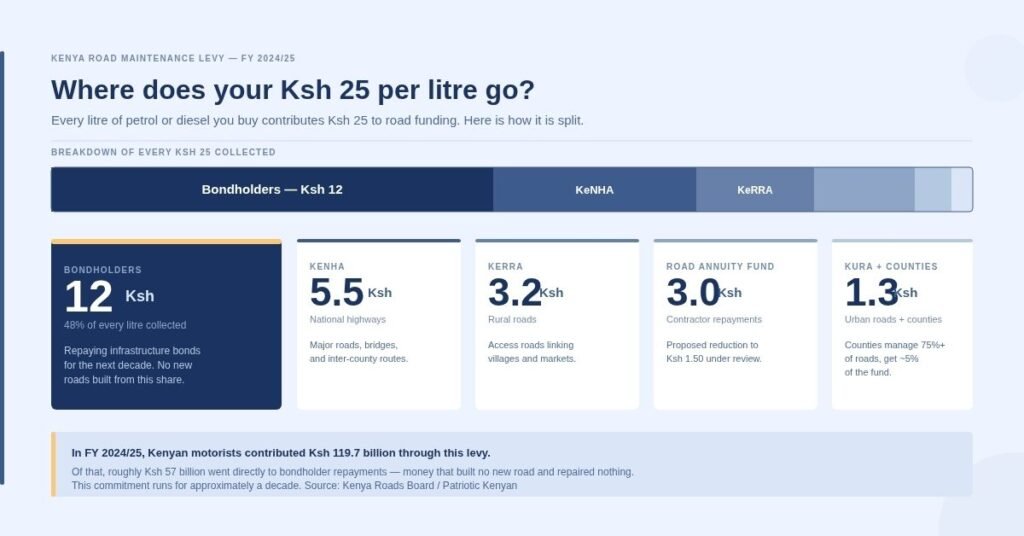
The fuel levy is not deposited into a single undifferentiated pool. It is split among road agencies, special funds, and in recent years, a growing share has been securitised and pledged to investors. The table below shows the current distribution structure.
The Kenya Roads Board’s data shows that the fund collected Ksh 119.7 billion in FY 2024/25. That is a significant revenue stream, but as the following sections explain, a large portion of it is committed before any physical road work begins.
The Securitisation of the Fuel Levy
This is arguably the most consequential aspect of the current roads funding model, and one that receives very little attention in public discourse.
The government has securitised Ksh 7 per litre of the RMLF, channelling it through a Special Purpose Vehicle to raise Ksh 175 billion and settle outstanding contractor debts across KeNHA, KeRRA, and KURA. It is now moving to securitise an additional Ksh 5 per litre, bringing the total pledged to bondholders to Ksh 12 out of every Ksh 25 collected. Full details on the levy structure and its distribution are published by the Kenya Roads Board on an annual basis.
In practical terms, this means that for the next decade, close to half of every shilling you contribute through the fuel levy is going toward repaying infrastructure bonds, not toward building or repairing roads today. The argument for the model is that securitisation unlocked cash to clear a logjam of stalled projects. In FY 2024/25, the country built 761 km of roads against a target of just 206 km, a meaningful overachievement tied directly to the settlement of pending contractor bills. The long-term cost, however, is a decade of constrained levy allocations for active maintenance.
The County Funding Dispute
Counties are responsible for managing more than three-quarters of Kenya’s road network. These are the access roads that connect markets, health centres, schools, and residential neighbourhoods. Despite this, counties received approximately Ksh 6 billion of the Ksh 119.7 billion collected in FY 2024/25. For a clearer picture of which roads fall under national versus county jurisdiction, read our breakdown of paved and unpaved roads in Kenya, which traces the classification of the country’s 177,800 km network.
The Council of Governors has demanded 42 percent of the RMLF, arguing that the 5 percent proposed under the Kenya Roads (Amendment) Bill 2025 is constitutionally inconsistent and practically inadequate. A High Court ruling in June 2025 declared the exclusion of counties from direct RMLF allocation unconstitutional, prompting the Court of Appeal to give Parliament until July 2026 to amend the law. The outcome of that legislative process will have a direct bearing on the quality of roads in most parts of the country.
What This Means for the Average Kenyan
The revenue collection side of Kenya’s road funding is working. Ksh 119.7 billion in a single financial year is not a small number. The challenge is structural. Too much of that money is pre-committed to obligations from the past, leaving limited room to address the road conditions that motorists, commuters, and goods transporters experience today.
The outstanding government obligation in the roads sub-sector currently stands at approximately Ksh 850 billion, against a 2026/27 budget ceiling of just Ksh 70 billion. The government’s own estimate is that the sector needs approximately Ksh 320 billion annually over three years to fully clear the project backlog. At current allocation levels, that gap will not close any time soon.
The proposed reduction of the Road Annuity Fund contribution from Ksh 3 to Ksh 1.50 per litre would offer modest relief at the pump. Filling a 50-litre tank would cost roughly Ksh 75 less. However, it also raises questions about whether the government can meet existing annuity commitments while simultaneously managing a growing securitised portion of the same levy. These are not abstract fiscal debates. They are decisions that will shape the physical condition of Kenya’s roads for the next ten years.
Frequently Asked Questions (FAQ)
What is the Kenya Road Maintenance Levy?
The Kenya Road Maintenance Levy is a charge of Ksh 25 applied to every litre of petrol and diesel sold in Kenya. Established in 1993, it is collected by the Kenya Roads Board and distributed to KeNHA, KeRRA, and KURA for road construction, rehabilitation, and maintenance.
How much does Kenya collect from the fuel levy each year?
In the financial year ending June 2025, Kenya collected Ksh 119.7 billion through the Road Maintenance Levy Fund. This is the primary dedicated funding stream for road maintenance, separate from the national budget allocation of Ksh 217.3 billion proposed for FY 2025/26.
Why are roads still in poor condition despite the levy collections?
A significant portion of the levy, currently Ksh 12 per litre out of every Ksh 25, has been securitised and pledged to bondholders to repay infrastructure debts. This means much of the collected revenue is servicing past obligations rather than funding current repairs. The mismatch between county road responsibilities and county levy allocations compounds the problem further.
What does securitisation of the road maintenance levy mean?
Securitisation means the government has pledged a portion of future fuel levy collections to investors in exchange for upfront cash. That cash was used to settle verified pending bills owed to road contractors. Currently, Ksh 12 out of every Ksh 25 collected per litre is earmarked for bondholder repayments, a commitment that runs over the next decade.
How much of the RMLF do county governments receive?
Counties received approximately Ksh 6 billion of the Ksh 119.7 billion collected in FY 2024/25, despite managing over 75 percent of the road network. A High Court ruling in June 2025 declared this arrangement unconstitutional, and Parliament has until July 2026 to revise the distribution framework under the Kenya Roads (Amendment) Bill 2025.