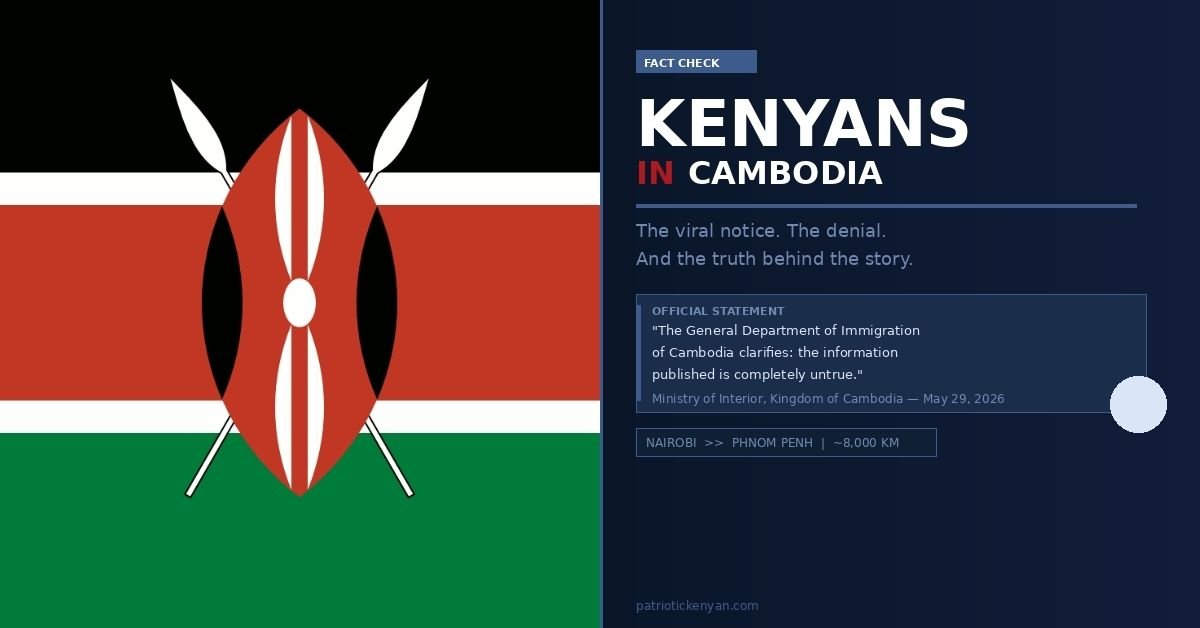
A document claiming that Cambodia had ordered all African nationals to leave the country by May 31, 2026 spread rapidly across social media this week, triggering alarm among Kenyans in Cambodia and their families back home. The notice named Kenya, Ghana, Uganda, and Cameroon by name and threatened a two-year jail term and an $8,000 fine for anyone who remained past the deadline. On May 29, 2026, the Cambodian government officially dismissed the document as a fabrication. But the panic it caused is real, and the reasons why it spread so easily reveal something important about what is actually happening to Africans in Southeast Asia right now.
Table of Contents
Where Exactly Is Cambodia?
Cambodia is a country in mainland Southeast Asia, bordered by Thailand to the northwest, Laos to the north, Vietnam to the east, and the Gulf of Thailand to the southwest. Its capital is Phnom Penh, a city of roughly 2.3 million people. The country sits roughly 8,000 kilometres from Nairobi and is not a typical destination for Kenyan travellers. Most Kenyans who end up there arrive through recruitment channels, often for jobs that turn out to be fictitious or exploitative. That context matters for understanding why a fake deportation notice spread as fast as it did.
What the Viral Notice Actually Said
The document appeared to be an official circular from the General Department of Immigration, bearing the names of Lieutenant General Som Sopheak and General Sar Sokha of Cambodia’s Ministry of Interior. It stated that a waiver previously granted to African nationals with immigration-related fines had officially expired, and that all affected individuals had to leave Cambodia on or before May 31, 2026.
The notice further warned that anyone found in Cambodia from June 1 would be arrested at the airport or at any location, sentenced to two years in prison, and required to pay $8,000 before being permitted to leave. It added that Cambodian police would actively search for overstaying foreigners from that date. The document was published by at least two West African news websites before spreading widely across WhatsApp groups and social media platforms in Kenya and across the continent.
Cambodia Says: It Is Fake
On May 29, 2026, the General Department of Immigration under Cambodia’s Ministry of Interior issued a formal clarification. The statement was unambiguous: no such directive had been issued.
Cambodian authorities further urged the public to verify all immigration information exclusively through the official General Department of Immigration website or its hotlines, rather than relying on third-party publications. Xinhua, the Chinese state news agency, also reported on the denial, with Cambodia describing the original document as fake news fabricated to distort the situation and mislead domestic and international audiences.
Why the Fake Notice Spread So Easily
A fabricated document does not cause this level of panic unless it is landing in fertile ground. And in this case, it did. The notice resonated because the underlying situation it described, Africans stranded in Cambodia under precarious immigration arrangements, is real.
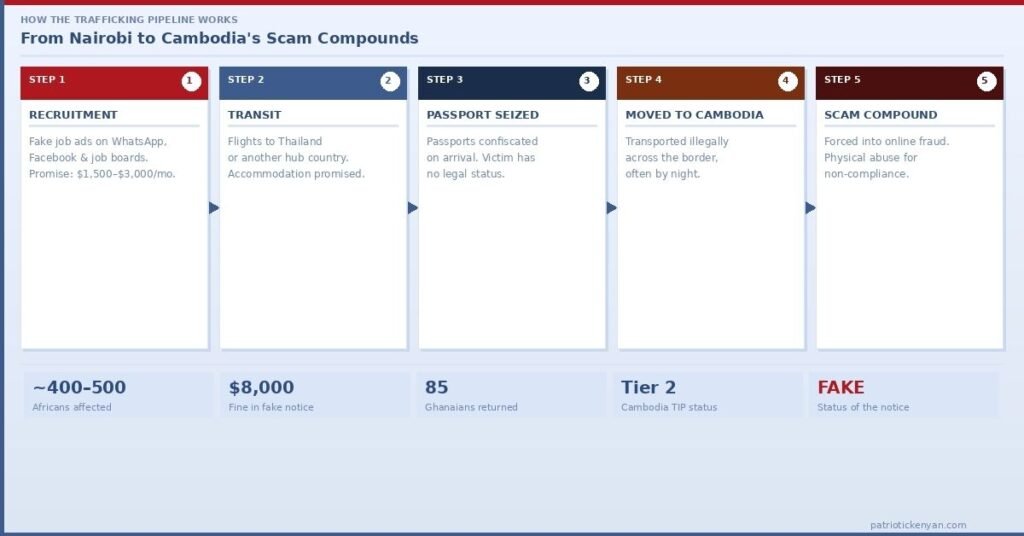
The scam compound network
Cambodia has for several years been documented as a hub for large-scale online fraud operations known as scam compounds. These are industrial facilities, often located in special economic zones near Cambodia’s borders, where trafficked workers are coerced into conducting online scams targeting victims across Asia, Africa, Europe, and North America.
The 2025 US State Department Trafficking in Persons Report placed Cambodia in its Tier 2 Watch List, noting that senior officials and business elites were reportedly involved in and profiting from these operations. International pressure, including from the United States and the United Nations, has pushed Cambodia to take action against the compounds, though critics say enforcement has been uneven.
How Africans end up there
Recruiters target young Africans, including Kenyans, through social media, WhatsApp, and job boards with offers of customer service roles, casino work, and technology jobs in Asia. Monthly salaries of $1,500 to $3,000 are promised, with flights and accommodation included. Upon arrival in a transit country, typically Thailand, passports are confiscated. Recruits are then moved illegally into Cambodia and put to work in scam compounds. Those who resist face physical abuse or are sold to other facilities. Many accumulate immigration violations during the process, which is precisely the kind of irregular status the fake notice was designed to target in its framing.
Ghana and the voluntary return programme
One detail that adds context: Ghana’s High Commission in Malaysia, which is concurrently accredited to Cambodia, confirmed it had facilitated the return of 85 Ghanaian nationals between March and May 2026. Arrangements were underway to assist an additional 76 Ghanaians who wished to return home voluntarily. This confirms there is an active diplomatic channel for repatriation, and that African governments are aware of the situation on the ground.
What This Means for Kenyans
The Kenyan government had not issued a formal statement on the viral notice at the time of publication, either to amplify the alarm or to confirm the Cambodian denial. That silence is worth noting. The Ministry of Foreign Affairs’ nearest diplomatic presence to Cambodia is the High Commission in Singapore.
The pattern of Kenyans abroad being caught in fast-moving foreign situations with limited government response is not new. It appeared in how global oil shocks from the Iran war hit Kenyan consumers at the pump, and it surfaces again here: the systems that should protect Kenyans abroad are often several steps behind the crises they face.
If you or someone you know is in Cambodia
The Bigger Picture: Misinformation and a Real Crisis
The fake notice is gone. The underlying problem is not. Myanmar, Laos, and the Philippines have also been identified as locations for similar fraud networks, and victims from across sub-Saharan Africa, including Kenya, Nigeria, Ghana, Tanzania, and Uganda, have been documented in multiple cases.
What the panic over this viral document makes visible is the information vacuum that surrounds the experiences of Africans in Southeast Asia. Families back home have little reliable access to verified information about what is happening to relatives in these countries. That vacuum is exactly where fabricated documents do the most damage. Until there is a more robust official channel for verified information, Kenyans will remain vulnerable to the next document that circulates on WhatsApp and sounds plausible because the situation it describes is partly true.
Frequently Asked Questions
Did Cambodia order Kenyans and other Africans to leave the country by May 31, 2026?
No. Cambodia’s General Department of Immigration issued an official statement on May 29, 2026, describing the widely circulated notice as completely untrue. The Cambodian government said no such directive had been issued and urged the public to rely only on official government channels for immigration information.
Where did the fake notice come from?
The document was published by at least two West African online news websites before spreading via WhatsApp and social media. Cambodia’s Ministry of Interior described it as fabricated and designed to distort the situation and mislead international public opinion. The origin of the document itself has not been publicly confirmed.
Are there actually Kenyans and other Africans stranded in Cambodia?
Yes. The fake notice gained traction because it described a situation with real foundations. A number of African nationals, including Kenyans, have ended up in Cambodia after being trafficked under the guise of legitimate job offers. Ghana’s High Commission in Malaysia confirmed it had helped 85 Ghanaians return home between March and May 2026, with arrangements underway for a further 76 who wished to leave voluntarily.
What are Cambodia’s scam compounds and how do they involve Africans?
Scam compounds are large facilities, often in Cambodia’s border regions, where trafficked workers are forced to conduct online fraud. Africans are recruited through social media job advertisements promising salaries of $1,500 to $3,000 per month in customer service or technology roles. On arrival, their passports are confiscated and they are coerced into working for criminal networks. The 2025 US State Department Trafficking in Persons Report flagged Cambodia’s government for failing to adequately address these operations.
What should Kenyans do if they have family members in Cambodia they cannot reach?
Contact the Kenya High Commission in Singapore, which covers Cambodia diplomatically. You can also report to the Directorate of Criminal Investigations (DCI) in Nairobi if you believe someone is being held against their will. The International Justice Mission operates in Southeast Asia and works with trafficking survivors. For immigration questions, Cambodia’s official General Department of Immigration can be reached through www.immigration.gov.kh.
