Every time fuel prices spike, Kenyans are given the same explanation: global oil markets are to blame. The wars, the shipping disruptions, the crude price swings. These factors are real. But they do not fully explain why Kenya fuel prices consistently rank among the highest in East Africa, even when Uganda, Tanzania, and Ethiopia import from the same Gulf suppliers. A closer look at what sits between the import cost and your pump price reveals a layered system of levies and taxes that amplifies every global shock well beyond what the commodity alone justifies.
Table of Contents
What You Are Actually Paying For at the Pump
When you fill up in Nairobi today, the price on the board is not simply the cost of imported fuel plus a retail margin. It is the product of deliberate government policy: a set of charges, each with a stated justification, stacked onto every litre sold in the country. Understanding these charges is the only way to make sense of why Kenya consistently lands at the top of regional fuel price comparisons.
As of May 2026, the following charges apply per litre of super petrol in Nairobi:
Collectively, these charges account for roughly 35 to 40 percent of the final pump price, before the import cost, freight, Mombasa port handling charges, pipeline tariffs, and retail margins are even factored in.
The Road Maintenance Levy
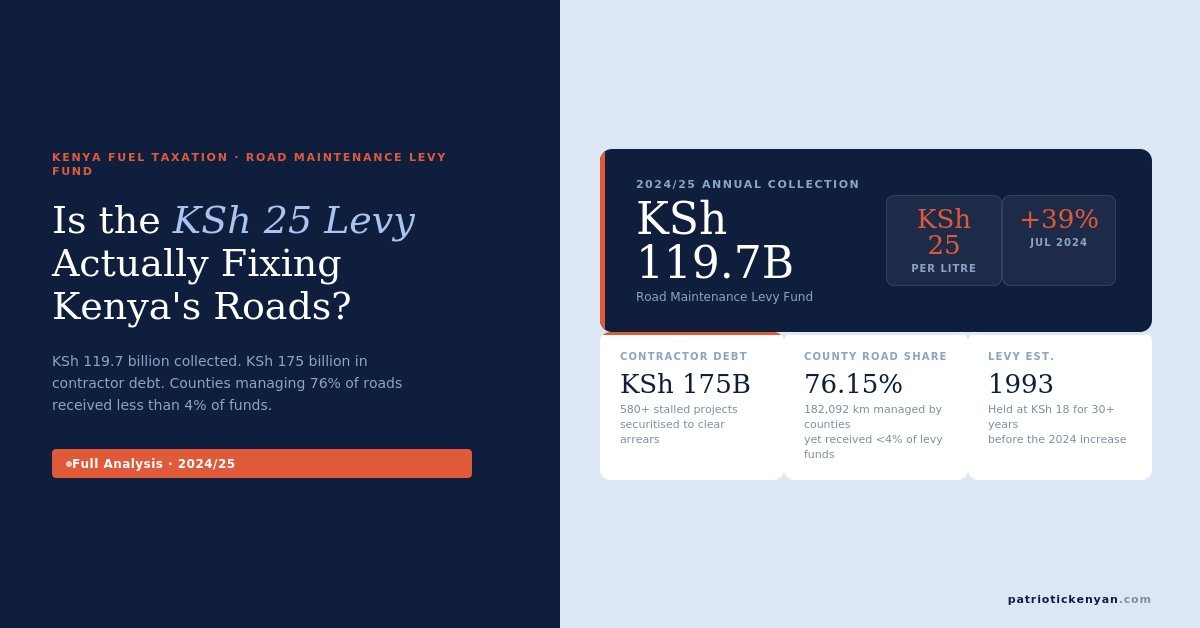
At KSh 25 per litre, the Road Maintenance Levy is the single largest charge on fuel. It was held at KSh 18 for several years before being raised to KSh 25 in July 2024, a move the Law Society of Kenya publicly challenged as lacking proper legal basis and violating constitutional principles around public participation. The funds are collected by the Kenya Roads Board and distributed to three national road agencies. Whether this levy is delivering proportionate value for the money Kenyans pay is examined in detail in our analysis of the Road Maintenance Levy.
The Anti-Adulteration Levy
Introduced in 2018, this levy addresses a specific market problem: rogue traders blending diesel with cheaper kerosene to earn an illicit margin. By raising the cost of diesel closer to kerosene prices, the levy reduces the financial incentive for adulteration. At KSh 18 per litre, it is the second-largest charge on your fuel bill, paid by every motorist regardless of whether their fuel was ever at risk of tampering.
Value Added Tax
VAT on fuel has been adjusted three times under public pressure. It stood at 16 percent for years, was cut to 13 percent during an earlier price crisis, and reduced again to 8 percent in April 2026 following nationwide transport protests over record diesel prices. The 8 percent rate is a temporary three-month measure. When VAT returns to the standard rate of 16 percent, it adds roughly KSh 24 to the cost of a litre of petrol on its own.
The Remaining Charges
The Railway Development Levy, Import Declaration Fee, Petroleum Development Levy, and Petroleum Regulatory Levy are smaller individually but together add approximately KSh 11 per litre. The Petroleum Development Levy deserves specific mention: it is collected during normal pricing periods and deployed when global costs spike sharply. In April 2026, approximately KSh 6.2 billion was drawn from this fund to partially cushion the latest price increase. Without it, the pump price impact would have been higher still.
How Kenya Compares to Its East African Neighbours
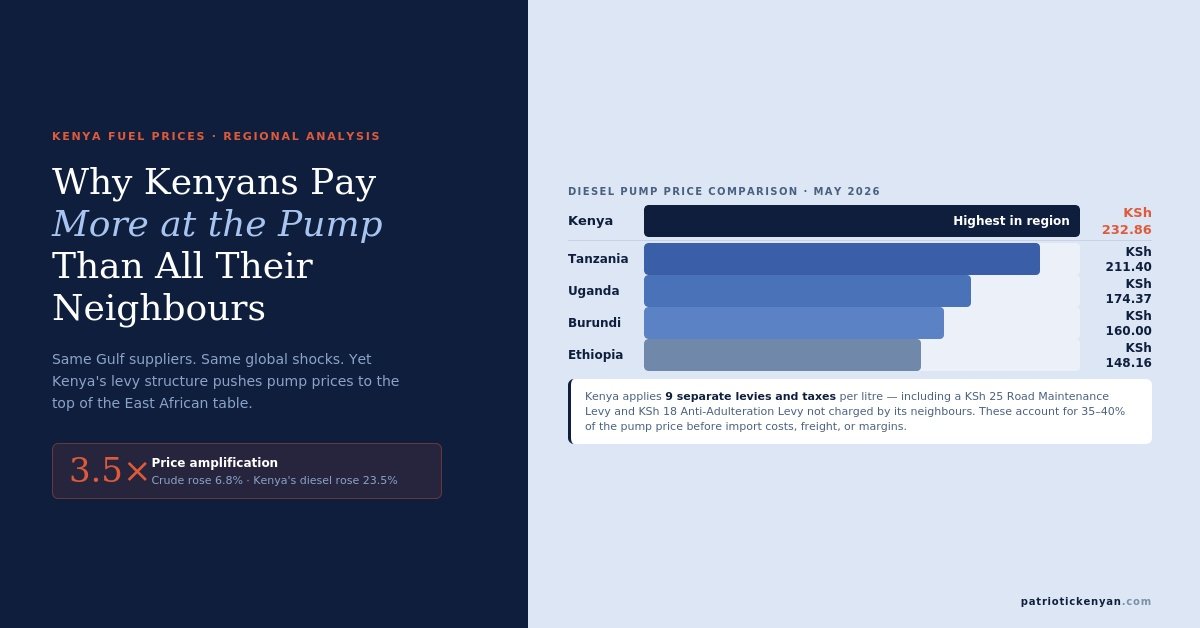
All of Kenya’s immediate neighbours source refined fuel from the same Gulf suppliers and have been exposed to the same Middle East supply disruptions in 2026. The pump prices, however, tell a very different story.
Uganda charges a higher VAT rate on fuel at 18 percent, compared to Kenya’s current 8 percent. Despite this, Uganda’s pump prices are substantially lower because it does not apply an Anti-Adulteration Levy, a Railway Development Levy, or a Petroleum Development Levy at the same scale. Tanzania’s fuel regulator uses a pricing formula with fewer levies. Ethiopia is a separate case: the government directly subsidises fuel prices by absorbing part of the import cost before it reaches consumers.
The Gap Between Global Shocks and What Kenyans Pay
The clearest evidence that Kenya’s domestic cost structure is the primary driver of its high fuel prices comes from the Kenya National Chamber of Commerce and Industry. Between March and April 2026, global crude oil prices rose by 6.8 percent. Over the same period, Kenya’s diesel pump price rose by 23.5 percent. That gap of nearly 17 percentage points is the direct result of a levy structure that amplifies every global price movement.
Kenya’s fuel pricing is administered monthly by the Energy and Petroleum Regulatory Authority (EPRA) using a formula that incorporates import costs, exchange rates, and all applicable levies and taxes. When global prices move, all of the fixed levies remain in place. The proportional effect on the pump price is therefore magnified well beyond what the underlying commodity shift would justify on its own.
What This Means Beyond the Petrol Station
Fuel prices do not stay at the pump. Diesel powers the matatus, trucks, and generators that move people, goods, and businesses across the country. When diesel climbs by KSh 46 in a single pricing cycle, transport operators pass the increase on immediately. Matatu fares go up. The cost of moving produce from farms to markets increases. The price of nearly everything that requires transport shifts higher within days.
The KNCCI has directly warned that Kenya’s fuel pricing is weakening the country’s competitiveness in transport, manufacturing, and logistics against regional peers. A manufacturer in Nairobi running diesel generators and a delivery fleet is paying KSh 232 per litre. Their counterpart in Dar es Salaam is paying approximately KSh 211. Against Uganda, the diesel gap is close to KSh 59 per litre. Scaled across operations, that difference is a structural cost disadvantage that cannot be absorbed through efficiency alone.
The government holds several levers. The Petroleum Development Levy can be deployed more aggressively during price shocks. VAT can be reduced, as demonstrated in April 2026. The Anti-Adulteration Levy is worth revisiting given how significantly the pricing environment has changed since 2018. But without structural reform to the levy framework, every Kenyan motorist will continue carrying a tax burden that goes substantially beyond the cost of the fuel in their tank.
Frequently Asked Questions (FAQ)
Why are Kenya fuel prices higher than Uganda and Tanzania if they import from the same suppliers?
Kenya applies more levies per litre than its neighbours, including the Road Maintenance Levy at KSh 25, the Anti-Adulteration Levy at KSh 18, a Railway Development Levy, and a Petroleum Development Levy. Uganda charges a higher VAT rate on fuel at 18 percent compared to Kenya’s current 8 percent, but it does not apply most of Kenya’s additional levies. The cumulative difference results in a substantially lower pump price.
What is the Anti-Adulteration Levy and why does Kenya charge it?
Introduced in 2018, the Anti-Adulteration Levy was designed to discourage the practice of blending diesel with cheaper kerosene for illicit profit. By narrowing the price gap between the two products, the levy reduces the financial incentive for adulteration. It adds KSh 18 to every litre of diesel sold in the country.
What is the Petroleum Development Levy used for?
The Petroleum Development Levy acts as a price stabilisation reserve. It is collected at KSh 5.40 per litre during normal pricing periods and deployed to cushion consumers when global oil prices spike. In April 2026, approximately KSh 6.2 billion was drawn from this fund to offset part of the diesel price increase that followed Middle East supply disruptions.
Will Kenya fuel prices come down if global oil prices fall?
A fall in global crude prices will reduce the import component of the pump price. However, because Kenya’s levy structure applies fixed charges per litre regardless of global prices, pump prices will not fall proportionally with crude. The fixed levies create a price floor that limits how far domestic prices can decline even during periods of global easing.
What is EPRA’s role in setting Kenya fuel prices?
The Energy and Petroleum Regulatory Authority sets maximum pump prices every month using a formula that incorporates import costs, exchange rates, applicable levies, taxes, and regulated margins. Fuel retailers cannot legally charge above the EPRA-determined price, though they may charge less. EPRA publishes the full pricing build-up each month.
Sources: EPRA, Kenya National Chamber of Commerce and Industry (KNCCI), Business Daily Africa, The EastAfrican, Africa Check, Kenyan Wallstreet