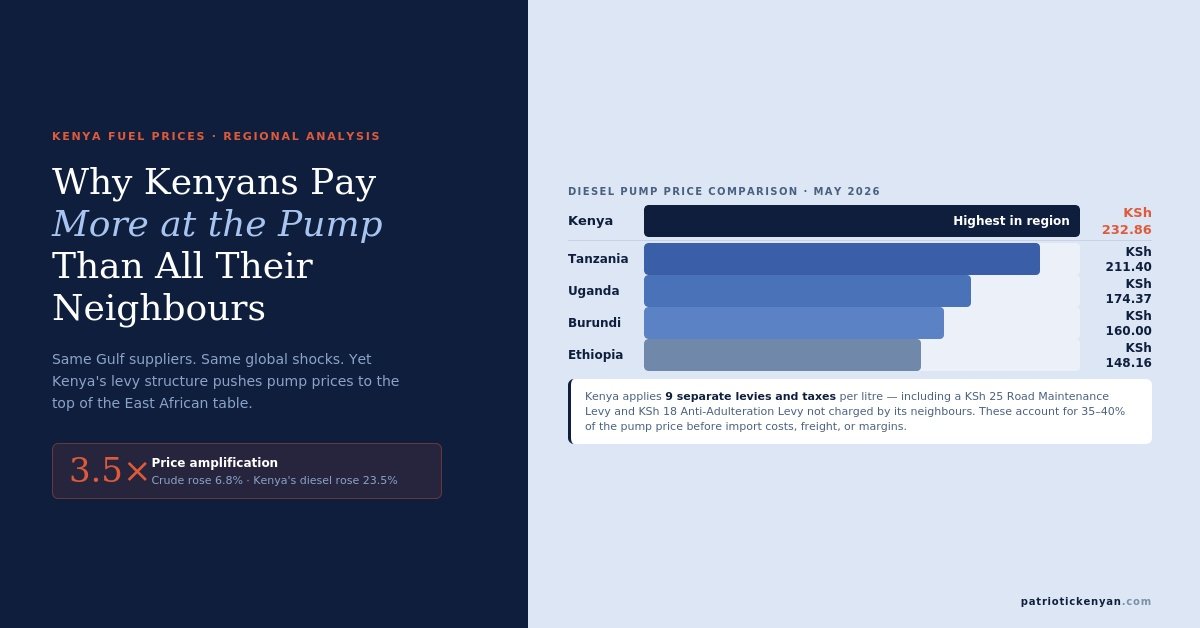
Each time a Kenyan motorist fills up, KSh 25 flows directly to the Road Maintenance Levy. Kenya collects more through this single charge than most of its neighbours recover across their entire fuel levy frameworks. It is the largest individual fee on every litre of fuel sold in the country, and the government’s primary justification for why Kenyans pay more at the pump than East African peers.
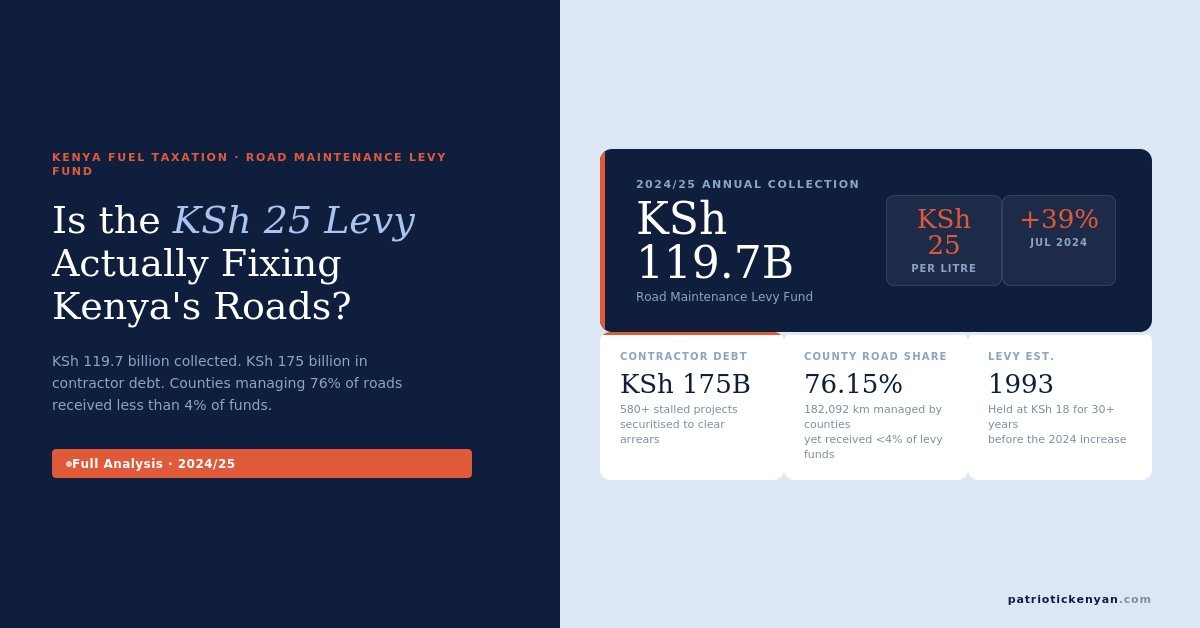
In the 2024/25 financial year, this levy collected KSh 119.7 billion from motorists. Below, we examine what happens to that money, whether the infrastructure it funds justifies the cost, and what independent data reveals about the roads argument.
Table of Contents
A History of the Levy and How It Got to KSh 25
The Road Maintenance Levy Fund was established by an Act of Parliament in 1993. Its original purpose was straightforward: create a dedicated, ring-fenced pool of money collected from motorists to fund the upkeep of the country’s road network. For years, the levy sat at KSh 18 per litre. In July 2024, the government raised it to KSh 25, a 39 percent increase applied without advance public engagement.
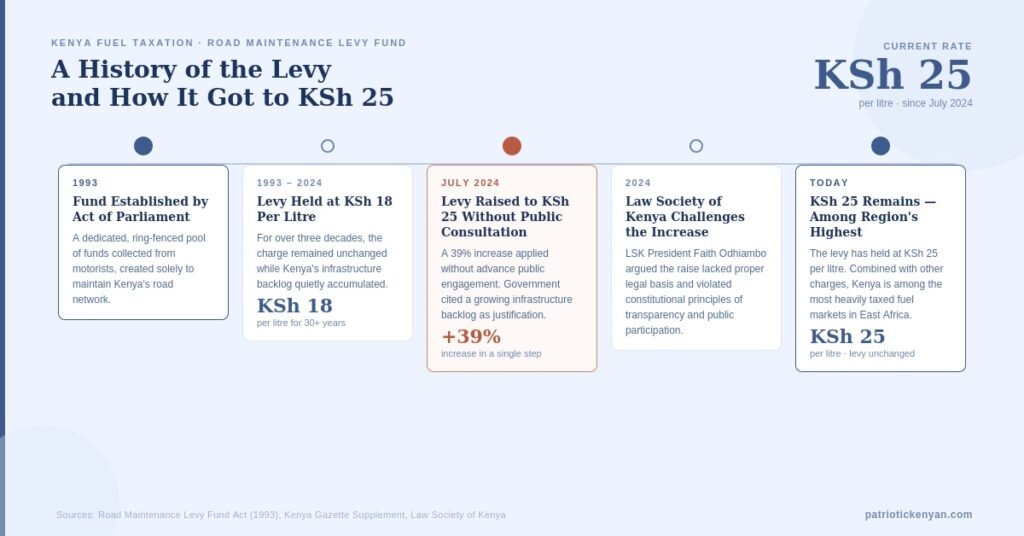
The Law Society of Kenya responded by challenging the increase, with LSK President Faith Odhiambo arguing that it was not founded on proper law and undermined the constitutional principles of transparency, accountability, and public participation. The government defended the increase as necessary to address a growing infrastructure backlog and pressed forward. The levy has remained at KSh 25 per litre since. The cumulative weight of this charge, alongside the other levies covered in our analysis of Kenya fuel prices, places Kenya among the most heavily taxed fuel markets in the region.
What KSh 119.7 Billion Collects and Where It Goes
In the 2024/25 financial year, the Road Maintenance Levy Fund collected KSh 119.7 billion. The Kenya Roads Board administers this fund and distributes it to three national road agencies. The table below shows how those disbursements were allocated as of January 2026, following the government’s securitisation of a portion of the levy.
The Kenya Roads Board serves as the link between the policy level and these implementing agencies, as explained in detail on the KRB website. KeRRA receives the largest share because it is responsible for the country’s classified rural road network, which covers the greatest physical distance of any single agency’s mandate.
The KSh 175 Billion Debt and the Securitisation Fix
The headline disbursement figures above did not emerge from a straightforward collection-and-spend cycle. By 2024, the road sector had accumulated KSh 175 billion in unpaid contractor bills. More than 580 road projects had stalled across the country because contractors, unpaid for completed work, had downed tools. This was not a sudden crisis: it built up over years of levy collections that were either redirected or insufficient relative to the volume of work commissioned.
To resolve it, the government securitised a portion of the Road Maintenance Levy. Specifically, the Kenya Roads Board pledged KSh 7 per litre of the levy as collateral to raise KSh 175 billion in upfront capital to clear contractor arrears. In November 2025, Cabinet approved securitising an additional KSh 5 per litre. The result is that a significant portion of every litre of fuel Kenyans buy today is not funding new road maintenance: it is servicing a debt taken on to pay for work that should already have been funded through previous levy collections.
Who Manages the Roads and Who Gets the Money
The most striking data point in the RMLF debate does not come from the national agencies. It comes from the counties. According to the Kenya Roads Register 2024, county governments manage 182,092 kilometres of roads — 76.15 percent of Kenya’s total 239,122-kilometre road network. Counties are responsible for the majority of the roads Kenyans use every day.
The KSh 6.84 billion shortfall was not an administrative oversight. The National Assembly had removed county governments as RMLF beneficiaries in budget amendments made in September 2023 and August 2024. Counties took the matter to court. In June 2025, the High Court ruled that excluding county governments from direct RMLF allocation was unconstitutional. The Court of Appeal subsequently gave Parliament until July 2026 to amend the Kenya Roads Act accordingly.
The Council of Governors is now pushing for 42 percent of the RMLF to be allocated to counties, on the basis that counties manage the overwhelming majority of the network. The Kenya Roads (Amendment) (No. 3) Bill, 2025, currently before a Senate committee, proposes only 5 percent. Kiambu Governor Kimani Wamatangi, speaking for the Council of Governors, put the matter plainly: the people who pay the levy on every litre of fuel expect their roads to be fixed by the government closest to them.
The 20,000 Kilometre Claim
In April 2026, President Ruto used the roads argument as his central defence for Kenya’s high fuel prices. He stated that Kenya’s roughly 20,000 kilometres of tarmacked roads surpass the combined paved road networks of all other East African countries, and that this infrastructure justifies the levy burden on Kenyan motorists.
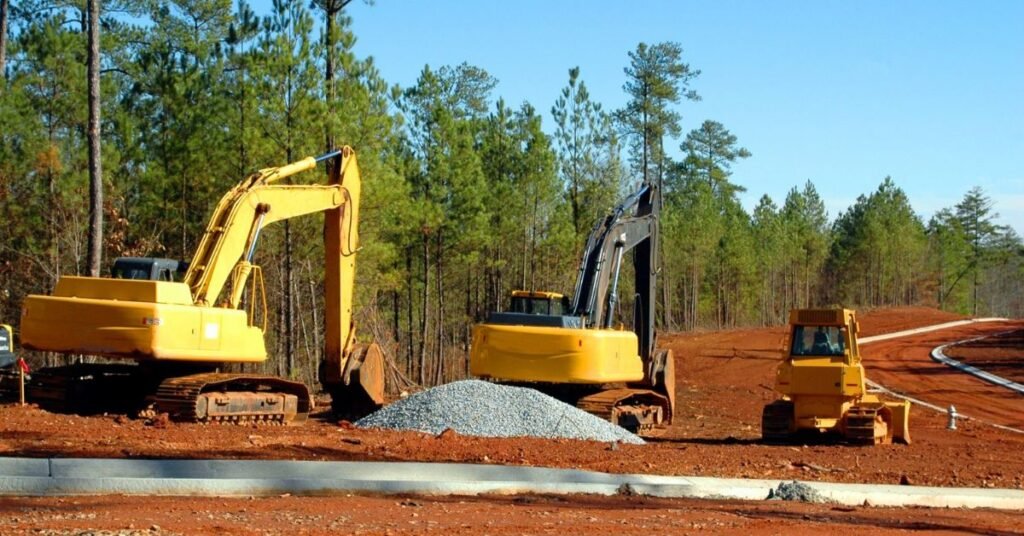
The Kenya Roads Register 2024 records Kenya’s total road network, including unpaved roads, at 239,122 kilometres. The 20,000-kilometre figure specifically refers to tarmacked roads, a much smaller subset. Independently verifying the regional comparison requires equivalent verified data from each EAC member state, which is not uniformly published in comparable formats. What the data does clearly show is that Kenya’s total classified road network is large by regional standards. What it does not settle is whether the distribution of the levy, and the efficiency with which it is spent, justifies its cost to individual motorists.
The more probing question is not whether Kenya has roads, but whether KSh 119.7 billion per year, plus securitised debt on top of that, is being deployed in a way that maximises value for the people paying the levy.
The World Bank Reality Check
President Ruto’s roads argument carries an implicit assumption: that Kenya’s infrastructure ambitions place it in a different economic bracket from its neighbours, one that justifies higher costs. The World Bank classification tells a different story.
Kenya is classified as a lower-middle-income country by the World Bank. So are Uganda, Tanzania, Rwanda, and Ethiopia. All five countries sit in the same income category. The citizens of these countries share broadly comparable purchasing power constraints. Yet Kenyan motorists pay substantially more at the pump than citizens in any of these peer economies, including those with comparable development goals and infrastructure needs.
The lower-middle-income classification does not, on its own, determine what a country should charge for fuel. But it directly challenges the framing that Kenya’s fuel levy burden is a natural consequence of its development level or infrastructure scale. Countries at the same income level, importing from the same sources, are managing their road networks at significantly lower cost to their motorists.
Is the Road Maintenance Levy Delivering Value for Money?
The case for the levy is real. Kenya does have a large road network that requires sustained funding to maintain. The securitisation mechanism has revived over 580 stalled road projects and injected liquidity across construction-linked supply chains. KRB has disbursed substantial sums to all three national agencies. These are genuine outcomes.
The case against is also substantial. The levy’s increase to KSh 25 was legally contested. A KSh 175 billion backlog of unpaid contractor bills had accumulated despite years of levy collection, raising serious questions about how funds were managed in prior cycles. Counties, which manage 76 percent of the network, received less than 4 percent of the 2024/25 RMLF collections. And a growing share of the levy is now pledged to debt repayment rather than available for active road maintenance.
The structural issue is that the Road Maintenance Levy was designed as a user-pay mechanism to fund roads in a straightforward cycle: collect from motorists, maintain roads. What it has become is something more complex: a securitised revenue stream, a contested intergovernmental resource, and a political argument deployed to justify pump prices that sit at the top of the regional table. Whether it delivers value depends considerably on which Kenyan you ask, and whether the road outside their door has been graded recently.
Frequently Asked Questions (FAQ)
What is the Road Maintenance Levy in Kenya and who collects it?
The Road Maintenance Levy is a statutory charge applied to every litre of fuel sold in Kenya. It currently stands at KSh 25 per litre, up from KSh 18 in previous years. It is collected by the Kenya Revenue Authority and administered by the Kenya Roads Board, which then distributes the funds to three national road agencies: KeNHA, KeRRA, and KURA.
How much does Kenya collect through the Road Maintenance Levy each year?
In the 2024/25 financial year, the Road Maintenance Levy Fund collected KSh 119.7 billion. In addition to regular collections, the government securitised a portion of the levy to raise KSh 175 billion in 2025 to clear accumulated contractor arrears.
Why was the Road Maintenance Levy increased from KSh 18 to KSh 25 per litre?
The government raised the levy in July 2024 citing the need to accelerate road maintenance and infrastructure development. The Law Society of Kenya challenged the increase, arguing it lacked proper legal grounding and violated constitutional requirements around public participation. The increase remains in place as legal proceedings continue.
Is Kenya’s road network larger than all other East African countries combined?
President Ruto stated in April 2026 that Kenya’s roughly 20,000 kilometres of tarmacked roads surpass the combined total of its East African neighbours. According to the Kenya Roads Register 2024, Kenya’s total road network stands at 239,122 kilometres. Independent verification of the tarmac comparison against all EAC members is difficult without equivalent verified data from each country, and the claim has been disputed by analysts.
Why do counties receive so little of the Road Maintenance Levy given that they manage most of the road network?
County governments manage 182,092 kilometres of roads, which is 76.15 percent of the national total. Despite this, counties received only KSh 3.68 billion from the levy in 2024/25 against a determined entitlement of KSh 10.52 billion. A High Court ruling in June 2025 declared the exclusion of counties from direct RMLF allocation unconstitutional. Parliament has until July 2026 to amend the law.
Sources: Kenya Roads Board, Kenya Parliament, Kenya Roads Register 2024, Business Daily Africa, The Star, Tuko.co.ke, Breaking Kenya News, Kenyan Wallstreet, Kenya Rural Roads Authority (KeRRA)